
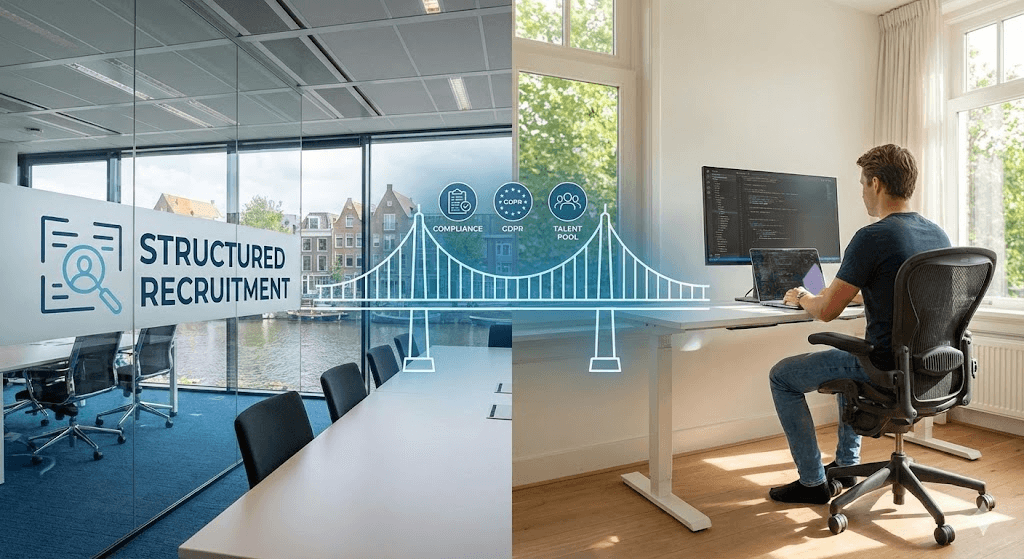
Remote IT Recruitment in the Netherlands: A Step-by-Step Guide for Modern Businesses
Remote IT Recruitment in the Netherlands: A Step-by-Step Guide for Modern Businesses
The Dutch tech ecosystem is strong, internationally connected, and innovation-driven. Amsterdam, Rotterdam, Utrecht, and Eindhoven continue to attract startups, scale-ups, and multinational tech companies. Yet one structural constraint continues to slow growth across the Netherlands: access to qualified IT talent.
Remote IT recruitment in the Netherlands has moved from optional experiment to strategic necessity. Dutch companies are no longer asking whether remote hiring works. They are asking how to implement it properly, compliantly, and at scale.
This guide explains what remote IT recruitment in the Netherlands means in practice, why it is accelerating, and how Dutch companies can build a structured, compliance-first hiring system.
Remote IT recruitment is no longer limited to startups experimenting with distributed teams. Established Dutch SMEs, funded scale-ups, and even enterprise innovation units are integrating remote engineers into their core product and infrastructure teams. The key difference between companies that succeed and those that struggle is structure. When remote hiring is treated as an extension of Dutch engineering governance rather than an external shortcut, performance stabilizes and delivery accelerates.
What Is Remote IT Recruitment in the Netherlands?
Remote IT recruitment in the Netherlands refers to the structured process of sourcing, hiring, onboarding, and managing IT professionals who work outside the Netherlands while supporting Dutch business objectives, governance standards, and compliance requirements.
Unlike freelance outsourcing, remote IT recruitment integrates engineers as long-term contributors with defined ownership, measurable outcomes, and clear employment structures.
In practice, this allows Dutch companies to access:
Software developers and backend engineers
DevOps and cloud specialists
Cybersecurity experts
Data scientists and AI engineers
QA and automation specialists
Remote IT recruitment expands the available talent pool beyond the local labour market while maintaining operational alignment with Dutch teams.
Why Remote IT Recruitment Is Growing in the Netherlands
The Dutch IT Talent Constraint
The Netherlands is one of Europe’s most competitive technology hubs. However, several structural pressures affect hiring:
Persistent shortage of experienced software developers
Long local hiring cycles, often extending several months
Rising salary expectations and benefits packages
Intense competition from large tech employers
For startups and scale-ups, these constraints create delivery risk. Product timelines extend. Roadmaps stall. Founders divert attention from growth toward recruitment.
Remote IT recruitment addresses this imbalance by widening the search radius while keeping operational control inside the Netherlands.
From Cost Strategy to Growth Strategy
Initially, remote hiring was framed primarily as a cost-saving tactic. Today, Dutch companies increasingly use it as a velocity strategy.
Remote IT recruitment enables:
Faster access to senior talent
Parallel development streams
Flexible scaling without long-term local overhead
Access to niche or emerging technical skills
The shift is strategic. Companies are not replacing local teams. They are extending them.
For example, many Amsterdam-based SaaS companies now use remote backend engineers to accelerate infrastructure projects while keeping product management and architecture leadership local. In Rotterdam and Utrecht, logistics and fintech firms increasingly rely on distributed DevOps and cloud specialists to maintain uptime and compliance standards without entering prolonged local hiring cycles. In Eindhoven’s deep-tech ecosystem, remote AI engineers supplement research-driven development teams.
This hybrid model reflects a broader Dutch business principle: combine local oversight with global capability.
Step 1: Define Your Remote IT Recruitment Needs Clearly
Before starting remote IT recruitment, Dutch companies must define scope precisely. Ambiguity in remote roles creates delays later.
Clarify Role Ownership
Instead of listing technologies only, define:
Which system or module this person will own
What business outcome their work supports
Who they collaborate with daily
What success looks like within 60 to 90 days
Clear ownership accelerates productivity and reduces miscommunication.
Technical and Security Requirements
Dutch companies should also define:
Required core technologies (e.g., Java, Python, cloud platforms)
Infrastructure access levels
Data protection and security standards
Reporting structure within the organization
For companies operating under GDPR and EU data protection rules, security clarity from the start is essential.
Structured preparation prevents expensive hiring mistakes.
Step 2: Choose the Right Remote Hiring Model
Not all remote IT recruitment models offer the same stability or compliance structure.
1. Freelancers
Freelancers provide flexibility but may present limitations in:
Long-term accountability
IP ownership clarity
Availability during scaling phases
For short-term tasks, freelancers can work well. For core systems, continuity matters.
2. Direct International Hiring
Hiring directly across borders introduces complexity:
Local employment law understanding
Payroll and tax administration
Contract enforceability
Permanent establishment risk
For most Dutch SMEs, this approach requires legal expertise and administrative resources.
3. Employer of Record (EOR) and Managed Recruitment
An Employer of Record model allows Dutch companies to hire international IT professionals compliantly without opening foreign entities.
This structure manages:
Employment contracts
Payroll and statutory obligations
Benefits administration
Local labour law compliance
GDPR-aligned data handling
For many Dutch companies, EOR-based remote IT recruitment provides the safest balance between flexibility and legal certainty.
A structured commercial overview is available under Outsource Talent.
Step 3: Selecting the Right Talent Market
Dutch companies evaluating remote IT recruitment often compare Eastern Europe, Asia, and emerging African technology hubs.
Nigeria has gained attention as a strategic talent source for several reasons:
Large and rapidly expanding developer ecosystem
Strong English proficiency
Experience collaborating with European companies
Competitive cost-to-quality balance
Time zone alignment with Central European Time
Time zone compatibility is particularly relevant for Dutch teams operating in CET. Overlapping working hours allow real-time collaboration, same-day code reviews, and faster iteration cycles.
Remote IT recruitment works best when collaboration physics support delivery speed.
When time zones align closely with Central European Time, Dutch teams avoid the common bottleneck of overnight feedback loops. Daily standups remain interactive. Urgent production fixes can be deployed within the same business day. Product managers do not need to wait 24 hours for clarifications. These small operational advantages compound over months into measurable velocity gains.
Step 4: Vet and Assess Remote IT Candidates Properly
Hiring remotely requires structured assessment.
Technical Evaluation
Effective technical screening includes:
Stack-relevant coding challenges
Real-world problem simulations
Code review exercises
Portfolio or repository evaluation
The goal is not to test trivia but to evaluate decision-making and code quality under realistic conditions.
Communication and Cultural Fit
Remote IT recruitment in the Netherlands requires strong communication alignment.
Assess:
Clarity in written explanations
Ability to restate requirements
Responsiveness during collaboration
Experience working with European teams
Remote engineers must operate autonomously while integrating smoothly with Dutch company culture.
Step 5: Ensure Legal, Payroll, and GDPR Compliance
What Does GDPR-Compliant Remote IT Recruitment Mean for Dutch Companies?
For Dutch organizations, GDPR compliance is not optional. Remote IT recruitment becomes GDPR-compliant when data access, processing, storage, and transfer are governed by formal agreements and technical safeguards that mirror Dutch and EU regulatory standards. This includes role-based access control, encrypted environments, documented processing purposes, and clearly defined data retention policies.
When remote engineers access staging or production systems, Dutch companies must ensure that confidentiality, intellectual property protection, and audit trails are contractually secured. Without these safeguards, cross-border collaboration can introduce invisible risk that only becomes apparent during security audits, investment rounds, or acquisition due diligence.
A compliance-first structure strengthens not only legal security but also investor confidence.
Remote IT recruitment in the Netherlands cannot succeed without a clear compliance framework. Dutch companies operate under strict European labour and data protection regulations. When hiring internationally, legal exposure increases unless the structure is properly designed.
GDPR and Data Protection
Dutch organizations processing customer or user data must ensure that remote engineers operate under GDPR-compliant agreements. This includes:
Clear data processing agreements
Restricted access to sensitive environments
Secure infrastructure and encrypted communication
Defined intellectual property ownership
Without structured safeguards, cross-border hiring can create compliance gaps that become visible only during audits or due diligence processes.
Employment Classification and Risk
One of the most common mistakes in remote IT recruitment is worker misclassification. Treating long-term contributors as independent contractors may appear flexible, but it exposes companies to:
Backdated tax obligations
Social contribution liabilities
Legal disputes around termination rights
Permanent establishment risk
For Dutch SMEs and startups, this legal uncertainty can undermine investor confidence.
Employer of Record as Risk Mitigation
An Employer of Record structure removes these liabilities from the hiring company while maintaining operational control. Through an EOR model, the remote engineer is legally employed in their home jurisdiction, while the Dutch company directs daily work.
This model ensures:
Fully compliant employment contracts
Local payroll and statutory contributions
Benefits administration aligned with local law
GDPR-aligned documentation and data handling
For companies exploring this structure in practice, the Pilot Program provides a structured validation phase that allows Dutch teams to test collaboration before scaling.
Compliance is not a bureaucratic formality. It is a structural foundation for sustainable remote IT recruitment in the Netherlands.
Step 6: Onboarding Remote IT Professionals Effectively
Why Onboarding Determines Remote Hiring Success
Research across distributed engineering environments consistently shows that onboarding quality determines long-term retention and productivity more than initial technical ability. Remote IT recruitment in the Netherlands therefore must include structured integration processes.
Dutch companies that treat onboarding as a strategic phase rather than an administrative step experience:
Faster contribution cycles
Lower early-stage churn
Stronger cultural integration
Higher codebase stability
Structured onboarding reduces ambiguity and accelerates confidence on both sides.
Hiring is only the beginning. Integration determines productivity.
Remote engineers cannot rely on informal office dynamics. Dutch companies must therefore design onboarding systems that reduce ambiguity and accelerate contribution.
Structured 30-60-90 Day Plan
A strong onboarding framework includes:
Clear first-week deliverables
Defined system access and tool setup
Documented architecture overview
Assigned internal point of contact
Within the first 30 days, the remote engineer should contribute to a contained task or feature. By day 60, ownership over a defined module should begin to stabilize. By day 90, measurable output aligned with business objectives should be visible.
Cultural Integration with Dutch Teams
Dutch workplace culture emphasizes directness, clarity, and accountability. Remote professionals must be introduced to this communication style early. Providing explicit expectations around feedback, sprint planning, and escalation processes prevents misunderstandings.
Companies should formalize:
Decision authority mapping
Code review standards
Documentation expectations
Response-time guidelines
When remote engineers understand how Dutch teams operate, collaboration becomes frictionless rather than reactive.
Dutch workplace culture values transparency and direct feedback. Remote professionals must understand:
Communication expectations
Meeting structure norms
Decision-making processes
Documentation standards
Encouraging overlapping working hours with CET enhances integration. Regular standups, sprint reviews, and one-on-one check-ins maintain alignment and accountability.
Remote IT recruitment succeeds when remote engineers feel structurally embedded rather than operationally peripheral.
Step 7: Performance Management and Scalable Growth
Building a Long-Term Remote Hiring Architecture
Remote IT recruitment in the Netherlands should not be treated as a single hire initiative. It functions best as an architectural layer within your organization.
This includes defining:
When to expand remote capacity
Which roles remain strategically local
How technical leadership distributes oversight
How knowledge transfer is documented
By formalizing these principles, companies avoid ad-hoc expansion and instead build scalable hybrid teams.
Remote IT recruitment becomes truly strategic when it supports long-term scaling.
Measuring Outcomes, Not Presence
Performance evaluation should focus on:
Feature delivery speed
Code quality and maintainability
System stability metrics
Contribution to team velocity
Outcome-based measurement aligns remote teams with Dutch business goals while avoiding micromanagement.
Building Hybrid Teams in the Netherlands
Many Dutch companies operate hybrid models where product leadership remains local while execution capacity expands globally. This structure enables:
Faster roadmap execution
Reduced recruitment bottlenecks
Balanced cost-to-quality optimization
Access to niche skills without permanent overhead
In Amsterdam and Rotterdam especially, where senior developer scarcity is acute, hybrid scaling prevents stagnation during growth phases.
A structured commercial framework for implementing this model is outlined under Outsource Talent.
Common Challenges and How Dutch Companies Solve Them
Even structured remote IT recruitment introduces challenges.
Communication Gaps
Solution:
Defined overlap hours
Asynchronous documentation standards
Transparent sprint planning
Trust and Accountability
Solution:
KPI dashboards
Clear ownership mapping
Regular review cycles
Security and Infrastructure Access
Solution:
Role-based permissions
Secure VPN environments
Multi-factor authentication
Structure replaces uncertainty.
The Future of Remote IT Recruitment in the Netherlands
Remote IT Recruitment and the Dutch Innovation Economy
The Netherlands continues to position itself as a European innovation gateway. However, demographic realities and local labour scarcity mean that domestic hiring alone cannot sustain projected digital growth.
Remote IT recruitment enables Dutch companies to:
Compete internationally for talent
Launch products faster
Enter new markets without structural relocation
Protect margins during scaling phases
In the Randstad region especially, where developer demand consistently outpaces supply, structured international recruitment reduces operational vulnerability.
Companies that integrate global engineering capacity while maintaining Dutch governance oversight are better positioned to withstand market volatility.
Remote IT Recruitment in a Broader European Context
Remote IT recruitment in the Netherlands is not simply about expanding geography. It is about engineering a hiring system that balances access to global talent with Dutch governance standards.
For companies expanding beyond the Dutch market, it is useful to understand how Dutch hiring strategy fits into the broader European landscape. A structured Europe-wide hiring framework is outlined in The Complete Guide to Remote Developer Hiring for European Startups, which explains how compliance, scaling models, and distributed governance operate across multiple EU jurisdictions.
Cost considerations are another decisive factor for Dutch companies. A detailed breakdown of international hiring economics, including salary structures, overhead comparison, and long-term retention impact, is covered in How Nigerian Developers Cut IT Hiring Costs by 50 Percent in Europe. Reviewing those cost mechanics helps contextualize why remote IT recruitment is increasingly positioned as a structural growth decision rather than a short-term workaround.
When role clarity, hiring model structure, time zone alignment, and candidate vetting are aligned, remote IT recruitment becomes a stable extension of your internal engineering organization rather than an external experiment.
Frequently Asked Questions About Remote IT Recruitment in the Netherlands
Is remote IT recruitment suitable for Dutch SMEs?
Yes. Small and medium-sized enterprises often benefit the most because they experience the highest friction in local hiring cycles. Remote recruitment provides access to senior-level expertise without enterprise-level overhead.
How long does remote IT recruitment typically take?
When working with pre-vetted talent pools and structured onboarding systems, Dutch companies can onboard remote IT professionals within weeks rather than months.
Can remote engineers align with Dutch working hours?
Yes. Time zone alignment with Central European Time ensures real-time collaboration and reduces iteration delays.
Does remote IT recruitment replace local hiring?
No. Most successful Dutch companies use a hybrid approach, combining local product leadership with global execution capacity.
Digital transformation continues to accelerate across Dutch industries. Fintech, logistics, healthtech, SaaS, and deep-tech firms increasingly depend on engineering velocity to maintain competitive advantage.
Remote IT recruitment is not a temporary workaround. It is becoming a core architectural component of Dutch growth strategy.
Companies that design compliant, structured, and scalable remote hiring systems will outperform those constrained by local scarcity alone.
Ready to Build a Structured Remote IT Team?
Remote IT recruitment in the Netherlands works when governance, compliance, onboarding, and performance systems operate together.
If your organization is evaluating how to expand engineering capacity without increasing local hiring risk, schedule a structured conversation via the Book Discovery Call.
A focused strategy discussion clarifies:
Role definition and ownership mapping
Compliance structure selection
Talent market evaluation
Scaling roadmap alignment
The Netherlands will remain a leading innovation hub. The companies that combine Dutch oversight with global engineering capability will define the next phase of growth.
ABOUT ALPHA GLOBAL
Alpha Global helps Dutch and European companies build high-performing engineering teams through remote and relocation models. With offices in Rotterdam and Lagos, we manage recruitment, compliance, payroll, and onboarding under one structured framework.
Typical hiring time: 21 days.
Book a Strategy Call
OUR CORE SOLUTIONS
Hire remote Engineers
Talent Relocation to the netherlands
Pilot Program - Hire Risk-Free
Related Article
Related Article 1 link
Related Article 2 link
Related Article 3 link
Contact & Legal
Alpha Global V.O.F.
KvK 95018050
Rotterdam, Netherlands
✉️ office@alpha-global.org
+31 68 555 84 25

© 2024 Alpha Global V.O.F. All rights reserved.
Explore