Bart Młodkowski
Europe’s tech ecosystem is expanding rapidly, but the talent pipeline is not keeping pace. Across the Netherlands, startups in Amsterdam, Rotterdam, Utrecht, and Eindhoven are competing aggressively for software developers, DevOps engineers, cloud specialists, and cybersecurity professionals. The result is predictable: longer hiring cycles, rising salary expectations, and mounting pressure on product delivery timelines.
For many Dutch founders, the challenge is no longer whether they can raise capital. The real constraint is hiring velocity. Without the right engineers in place, innovation slows, burn rate increases, and competitive advantage erodes.
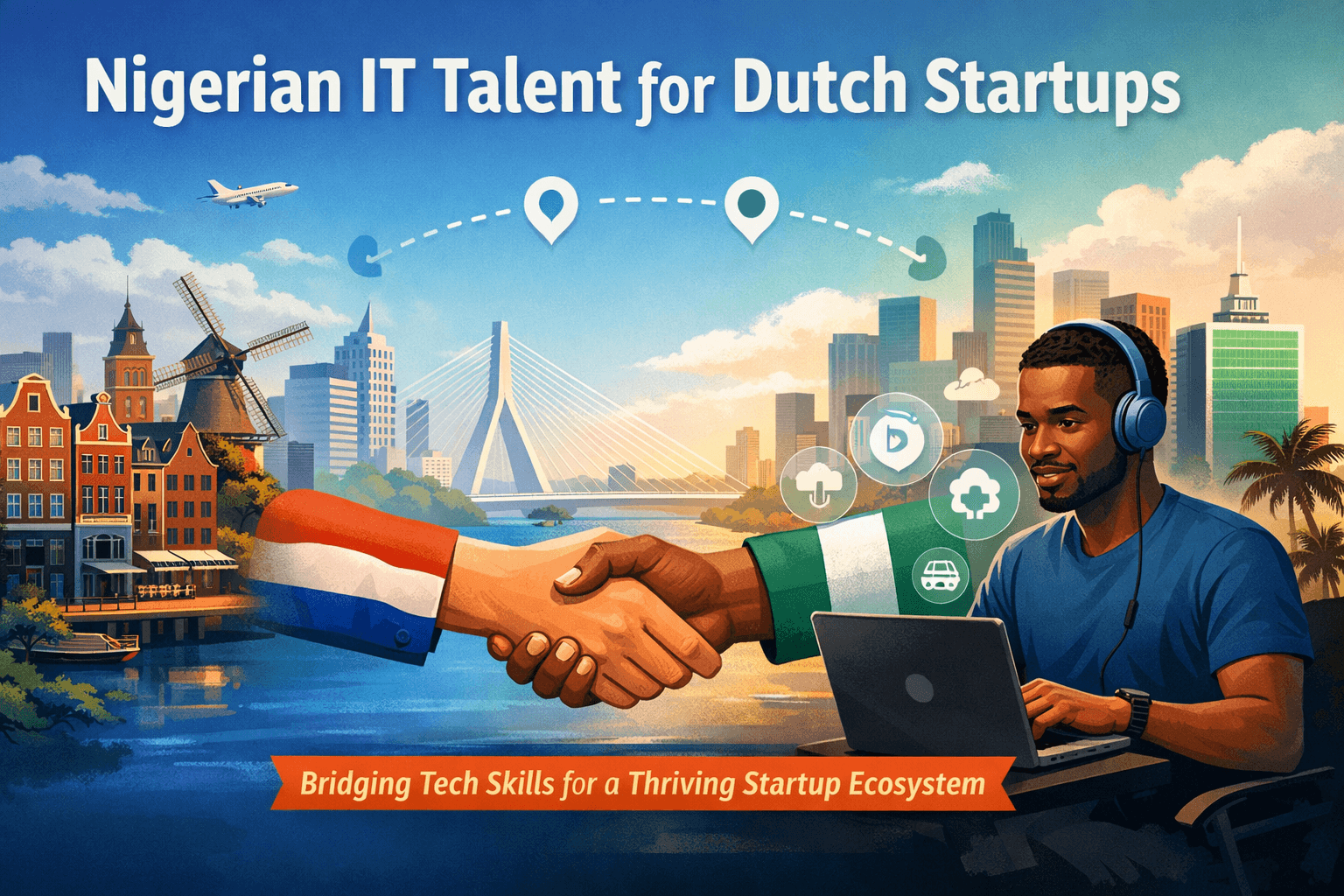
This is why a growing number of Dutch startups are turning to Nigerian IT talent as a strategic solution rather than a temporary outsourcing experiment.
Snippet definition: Nigerian IT talent for Dutch startups
Nigerian IT talent for Dutch startups refers to hiring software engineers, DevOps specialists, data professionals, and security experts based in Nigeria who work as integrated team members for Netherlands-based companies. The model works best when engineers operate within Dutch governance standards, collaborate in CET-aligned hours, and are engaged through compliant employment structures rather than ad-hoc freelance arrangements.
The key point is not geography. It is operational design. With the right structure, remote engineers become a predictable extension of the product team instead of a variable external dependency.
What Is Driving Europe’s Tech Skills Crisis?
The European technology skills shortage has been discussed for years, but its impact is now structural rather than cyclical. In the Netherlands specifically, demand for digital expertise consistently exceeds supply.
The Dutch Talent Bottleneck
Dutch founders often describe the same sequence. A role opens, interviews begin, and the short list looks promising. Then reality hits: candidates have multiple offers, notice periods stretch timelines, and salary expectations move upward during negotiation. Even when a hire is made, onboarding takes time and the team loses weeks of momentum.
For startups building in competitive categories like fintech, B2B SaaS, logistics, and marketplaces, those weeks are not neutral. They compound into missed releases, delayed integrations, and slower learning cycles.
Dutch startups face several recurring obstacles:
Shortage of experienced software engineers in key stacks such as JavaScript, Python, and cloud-native architectures
Extended recruitment timelines that often range from three to six months
Escalating salary levels, particularly for senior developers and DevOps specialists
Competition from large multinational tech firms offering premium compensation packages
For early-stage and growth-stage startups, these constraints directly affect runway. When a critical backend hire takes four months instead of four weeks, roadmap execution slows. Feature releases get postponed. Investor expectations tighten.
The Netherlands remains one of Europe’s strongest innovation ecosystems, yet local hiring alone is increasingly insufficient to sustain startup growth.
The Velocity Problem
The core issue for Dutch startups is not simply cost. It is speed.
Velocity is the ability to ship, measure, learn, and iterate. When engineering capacity is constrained, roadmap execution slows and competitive advantage erodes. Sales teams wait for features. Customer success teams wait for fixes. Founders start trading long-term architecture decisions for short-term patches.
Hiring locally often involves:
The core issue for Dutch startups is not simply cost. It is speed.
Hiring locally often involves:
Multiple interview rounds across several weeks
Competing offers and counteroffers
Delays caused by notice periods
Limited candidate availability in niche skill areas
In fast-moving SaaS, fintech, healthtech, and logistics platforms, this delay becomes a strategic disadvantage. Startups must iterate quickly. Remote IT talent provides an alternative route to restoring hiring velocity without sacrificing quality.
Why Nigerian IT Talent Is a Strategic Advantage for Dutch Startups
Dutch startups evaluating remote IT recruitment typically compare Eastern Europe, Asia, and emerging African markets. Nigeria has increasingly positioned itself as a high-potential talent hub for European companies.
1. A Rapidly Growing Developer Ecosystem
Nigeria has one of the most active technology communities in Africa, with strong developer networks and international exposure. Many mid-level and senior developers have experience in structured sprint environments with clear documentation and delivery standards, making integration into Dutch startup workflows significantly smoother.
Nigeria has one of the largest and fastest-growing technology talent pools in Africa. Each year, universities and technical programs produce graduates specializing in:
Full-stack software development
Backend engineering and APIs
Cloud infrastructure and DevOps
AI, data science, and machine learning
Cybersecurity and QA automation
More importantly, many Nigerian developers already have experience working with European startups and distributed teams. English proficiency is strong, communication barriers are minimal, and collaboration within agile frameworks is common.
For Dutch startups seeking remote IT talent aligned with European workflows, this combination is strategically relevant.
2. Time Zone Alignment with the Netherlands
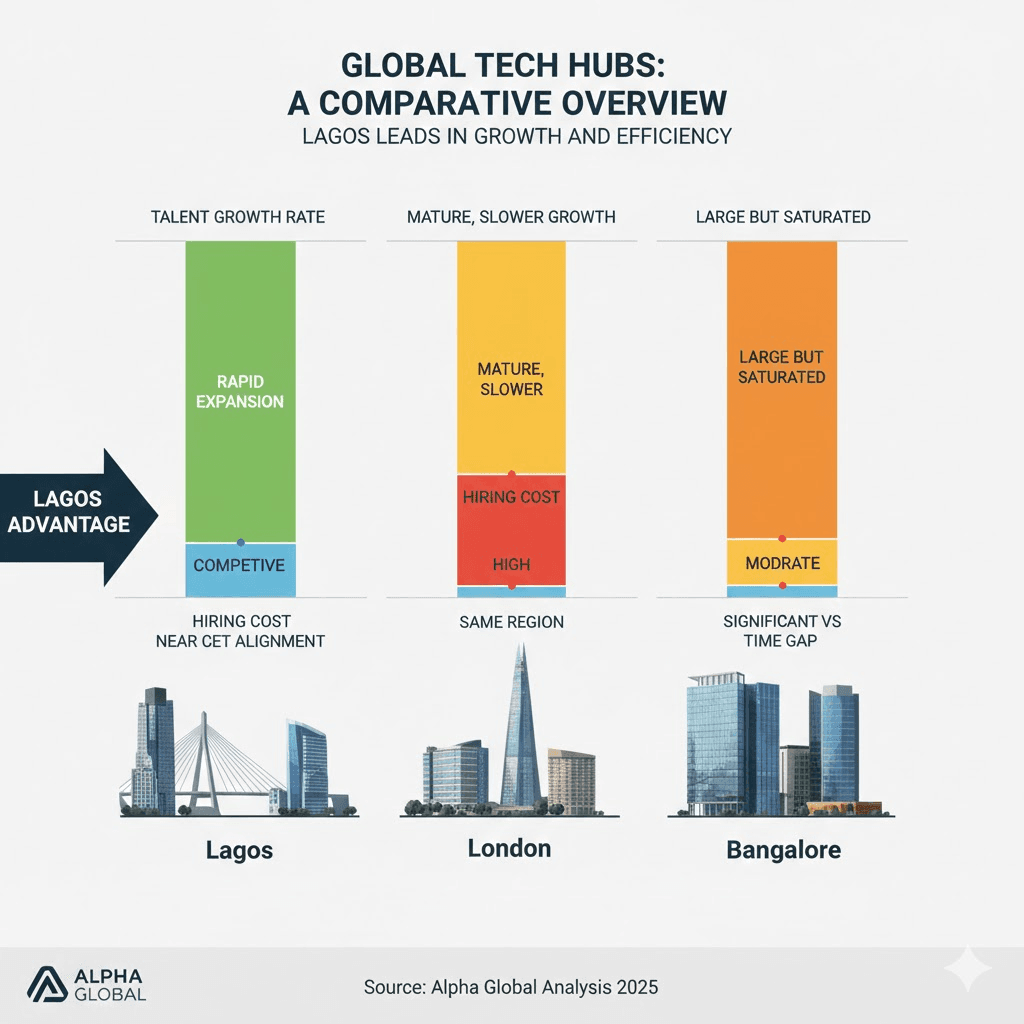
Operational efficiency in remote teams often depends on time zone overlap. Nigeria operates on West Africa Time, which aligns closely with Central European Time.
That means collaboration can remain synchronous without forcing late-night meetings or next-day feedback loops. For Dutch startups, this is one of the biggest differences between a remote team that feels integrated and a remote team that feels distant.
This overlap enables:
Real-time standups
Same-day code reviews
Faster bug resolution cycles
Immediate clarification of product requirements
Unlike remote hiring in significantly distant time zones, Dutch startups working with Nigerian IT talent maintain daily interactive collaboration. This reduces friction and accelerates sprint execution.
For founders in Amsterdam or Rotterdam, this practical alignment matters more than theoretical global access.
3. Cost Efficiency Without Sacrificing Quality
Cost is part of the equation, but it is not the only variable.
Dutch founders care about total cost of delivery, not only monthly salaries. A cheaper hire who delivers slowly is expensive. A well-structured remote hire who ramps quickly protects runway and accelerates revenue.
Nigerian IT talent offers Dutch startups the opportunity to:
Optimize salary expenditure while maintaining senior-level capability
Extend runway without lowering engineering standards
Reallocate budget toward growth, marketing, and product innovation
When combined with structured recruitment and compliance management, this cost-to-quality balance becomes a long-term competitive advantage rather than a short-term savings tactic.
A detailed economic breakdown is available in our guide to how Nigerian developers reduce IT hiring costs for European teams.
From Outsourcing to Structured Remote IT Recruitment
One reason Dutch startups hesitated in the past was confusion between outsourcing and structured remote team building.
The word outsourcing often carries baggage in the Dutch market. It can imply low ownership, fragmented delivery, and weak accountability. That is exactly why positioning matters.
Nigerian IT talent becomes a strategic advantage when it is framed as remote recruitment with governance, not as outsourcing with handoffs.
Outsourcing often implies:
Limited ownership
Project-based engagement
Weak integration into internal teams
Structured remote IT recruitment, by contrast, means:
Clearly defined role ownership
Direct integration into the startup’s product roadmap
Long-term collaboration under compliant employment structures
Transparent performance metrics
This model aligns with broader European hiring strategies discussed in our remote developer hiring guide for European startups.
For Dutch startups, the difference is critical. Nigerian IT talent is not filling temporary gaps. It is strengthening engineering capacity within a structured governance framework managed from the Netherlands.
When Dutch innovation culture combines with globally competitive engineering talent, the result is a scalable hybrid model. Product leadership remains local. Execution capacity expands internationally. Governance, compliance, and quality standards remain aligned with EU expectations.
This shift explains why Nigerian IT talent is increasingly seen not as an alternative option, but as a strategic solution to Europe’s deepening tech skills crisis.
How Dutch Startups Operationalize Nigerian IT Talent Successfully
Recognizing the opportunity is one thing. Implementing it correctly is another.
Dutch startups that succeed with Nigerian IT talent follow a structured framework built around governance, onboarding, compliance, and performance management. Without structure, remote hiring introduces risk. With structure, it compounds velocity.
Step 1: Define Outcome-Based Roles
Before engaging remote engineers, successful Dutch startups define roles in terms of ownership and business impact rather than just technology stacks.
Instead of saying:
“We need a React developer”
They define:
“We need an engineer to own our onboarding flow and reduce user drop-off within two quarters.”
This clarity allows Nigerian IT talent to operate with autonomy while remaining aligned with Dutch product strategy. It also reduces onboarding friction and prevents scope confusion.
Outcome-based structuring is particularly important for early-stage startups where every engineering decision affects runway.
Compliance, EOR, and Legal Certainty
A common question among Dutch founders is whether hiring Nigerian IT talent introduces regulatory risk.
The short answer: it does not, when structured correctly.
Employer of Record as Infrastructure
An Employer of Record model allows Dutch startups to hire internationally without setting up foreign legal entities. Under this structure:
The developer is legally employed in Nigeria
Payroll and statutory contributions are managed locally
Employment contracts are compliant with local labour law
The Dutch startup retains operational control and task direction
This eliminates permanent establishment risk, misclassification exposure, and payroll complexity.
For startups that want to validate collaboration before long-term scaling, the Alpha Global Pilot Program provides a structured testing phase to assess fit and performance under compliant conditions.
Legal clarity increases investor confidence and protects founders from hidden liabilities.
Onboarding Nigerian IT Talent into Dutch Startup Teams
Remote hiring fails most often during integration, not recruitment.
Dutch startups that treat onboarding as a strategic phase experience stronger retention and faster productivity.
30-60-90 Day Integration Model
A proven structure includes:
First 30 days: environment setup, codebase orientation, first contained deliverable
60 days: partial ownership of a defined feature or infrastructure component
90 days: measurable business impact tied to roadmap milestones
This phased integration ensures that Nigerian IT talent transitions from contributor to accountable team member within a predictable timeline.
Cultural and Communication Alignment
Dutch work culture values transparency, direct feedback, and clarity of responsibility. Successful remote teams formalize:
Weekly sprint reviews
Clear documentation standards
Defined escalation channels
Real-time overlap during CET working hours
Because Nigeria operates in a closely aligned time zone, this synchronization supports agile processes rather than disrupting them.
Protecting Runway Through Smarter Hiring
For venture-backed Dutch startups, hiring decisions directly influence burn rate.
Nigerian IT talent contributes to runway protection in three structural ways:
Lower average total employment cost while maintaining skill level
Faster hiring cycles that reduce idle roadmap time
Flexible scaling without long-term local overhead commitments
When startups reduce hiring delays, the financial impact extends beyond salary savings. Earlier feature launches accelerate revenue experiments and improve product-market fit.
In this context, international hiring becomes a growth lever rather than a budget adjustment.
Addressing Common Founder Concerns
Even with clear advantages, founders raise practical concerns around quality, integration, and accountability. Structured vetting, defined ownership, and regular sprint alignment mitigate these risks. When Nigerian IT talent is embedded directly into roadmap planning and review cycles, ownership remains fully aligned with the Dutch company’s product vision.
For startups seeking a commercial framework that combines recruitment, compliance, and long-term team integration, review Alpha Global’s managed remote hiring model.
Why This Model Fits the Dutch Startup Ecosystem
The Netherlands is uniquely positioned for hybrid engineering models.
Strong product leadership and innovation culture
High digital adoption across industries
International investor networks
Openness to remote-first collaboration
By combining Dutch strategic oversight with Nigerian IT talent execution capacity, startups gain structural resilience.
Amsterdam-based SaaS founders can accelerate feature velocity. Rotterdam logistics startups can expand infrastructure teams. Eindhoven deep-tech ventures can add AI expertise without waiting for scarce local hires.
The result is a hybrid model aligned with European compliance standards and global engineering capability.
The Strategic Outlook for Dutch Tech Founders
Europe’s skills shortage is not disappearing. Demographic shifts, digital acceleration, and increasing competition for experienced engineers will continue shaping the hiring landscape.
Startups that treat Nigerian IT talent as a strategic pillar rather than an emergency fix position themselves ahead of the curve.
Remote IT talent from Nigeria offers:
CET-aligned collaboration
Strong English communication
Competitive cost-to-quality balance
Scalable hiring infrastructure
Compliance-ready employment structures
When combined with structured governance, this model enables Dutch startups to compete globally without compromising quality or regulatory integrity.
Ready to Scale with Nigerian IT Talent?
Dutch startups that integrate global engineering talent early gain speed, flexibility, and strategic resilience.
If your team is evaluating how to accelerate hiring without increasing local bottlenecks, book a discovery call.
A structured conversation clarifies:
Role ownership and hiring priorities
Compliance model selection
Scaling roadmap alignment
Time-to-hire expectations
In a market defined by velocity, the startups that solve hiring structurally will lead the next phase of Dutch innovation.
ABOUT ALPHA GLOBAL
Alpha Global helps Dutch and European companies build high-performing engineering teams through remote and relocation models. With offices in Rotterdam and Lagos, we manage recruitment, compliance, payroll, and onboarding under one structured framework.
Typical hiring time: 21 days.
Book a Strategy Call


Contact & Legal
Alpha Global V.O.F.
KvK 95018050
Rotterdam, Netherlands
✉️ office@alpha-global.org
+31 68 555 84 25

© 2026 Alpha Global V.O.F. All rights reserved.